 Add to Chrome
 Add to Firefox
 Add to Edge
Turning Video Models into Generalist Robot Policies
May 27, 2026
Video generative models have emerged as a promising robotics backbone, capable of generating videos that depict the completion of complex tasks across embodiments and environments. Recent work proposes robot foundation models that jointly predict future observations and actions by finetuning video models with action-labeled data. In this paper, we test the limits of an alternative approach: leave the video planner as-is while training an embodiment-specific inverse dynamics model (IDM). This decoupling offers several natural benefits: the video planner remains embodiment-agnostic, different video models can be interchanged easily without re-training the IDM, and the IDM can be independently trained with readily available self-play data. We present a closed-loop, video-to-action policy that combines an action-free video world model with a carefully-designed IDM based on the robot embodiment Jacobian. We demonstrate that our IDM design is both data-efficient and scalable to high-dimensional action spaces. Our policy, which we coin the Video-to-Embodied Robot Action Model (VERA), achieves strong performance across simulated and real-world benchmarks, including zero-shot Panda arm manipulation and 16-DoF Allegro-hand dexterous cube re-orientation. The same video planner can be used across multiple embodiments by pairing it with different embodiment-specific IDMs. Our results show that decoupled video planning plus faithful video-to-action translation is a viable alternative route towards zero-shot, cross-embodiment, and generalizable robot control. More results are available on our project website: https://vera.csail.mit.edu.

OGPO: Sample Efficient Full-Finetuning of Generative Control Policies
May 04, 2026Generative control policies (GCPs), such as diffusion- and flow-based control policies, have emerged as effective parameterizations for robot learning. This work introduces Off-policy Generative Policy Optimization (OGPO), a sample-efficient algorithm for finetuning GCPs that maintains off-policy critic networks to maximize data reuse and propagate policy gradients through the full generative process of the policy via a modified PPO objective, using critics as the terminal reward. OGPO achieves state-of-the-art performance on manipulation tasks spanning multi-task settings, high-precision insertion, and dexterous control. To our knowledge, it is also the only method that can fine-tune poorly-initialized behavior cloning policies to near full task-success with no expert data in the online replay buffer, and does so with few task-specific hyperparameter tuning. Through extensive empirical investigations, we demonstrate the OGPO drastically outperforms methods alternatives on policy steering and learning residual corrections, and identify the key mechanisms behind its performance. We further introduce practical stabilizers, including success-buffer regularization, conservative advantages, $χ^2$ regularization, and Q-variance reduction, to mitigate critic over-exploitation across state- and pixel-based settings. Beyond proposing OGPO, we conduct a systematic empirical study of GCP finetuning, identifying the stabilizing mechanisms and failure modes that govern successful off-policy full-policy improvement.
Diamond Maps: Efficient Reward Alignment via Stochastic Flow Maps
Feb 05, 2026Flow and diffusion models produce high-quality samples, but adapting them to user preferences or constraints post-training remains costly and brittle, a challenge commonly called reward alignment. We argue that efficient reward alignment should be a property of the generative model itself, not an afterthought, and redesign the model for adaptability. We propose "Diamond Maps", stochastic flow map models that enable efficient and accurate alignment to arbitrary rewards at inference time. Diamond Maps amortize many simulation steps into a single-step sampler, like flow maps, while preserving the stochasticity required for optimal reward alignment. This design makes search, sequential Monte Carlo, and guidance scalable by enabling efficient and consistent estimation of the value function. Our experiments show that Diamond Maps can be learned efficiently via distillation from GLASS Flows, achieve stronger reward alignment performance, and scale better than existing methods. Our results point toward a practical route to generative models that can be rapidly adapted to arbitrary preferences and constraints at inference time.
Is Your Conditional Diffusion Model Actually Denoising?
Dec 21, 2025We study the inductive biases of diffusion models with a conditioning-variable, which have seen widespread application as both text-conditioned generative image models and observation-conditioned continuous control policies. We observe that when these models are queried conditionally, their generations consistently deviate from the idealized "denoising" process upon which diffusion models are formulated, inducing disagreement between popular sampling algorithms (e.g. DDPM, DDIM). We introduce Schedule Deviation, a rigorous measure which captures the rate of deviation from a standard denoising process, and provide a methodology to compute it. Crucially, we demonstrate that the deviation from an idealized denoising process occurs irrespective of the model capacity or amount of training data. We posit that this phenomenon occurs due to the difficulty of bridging distinct denoising flows across different parts of the conditioning space and show theoretically how such a phenomenon can arise through an inductive bias towards smoothness.
e3: Learning to Explore Enables Extrapolation of Test-Time Compute for LLMs
Jun 10, 2025Test-time scaling offers a promising path to improve LLM reasoning by utilizing more compute at inference time; however, the true promise of this paradigm lies in extrapolation (i.e., improvement in performance on hard problems as LLMs keep "thinking" for longer, beyond the maximum token budget they were trained on). Surprisingly, we find that most existing reasoning models do not extrapolate well. We show that one way to enable extrapolation is by training the LLM to perform in-context exploration: training the LLM to effectively spend its test time budget by chaining operations (such as generation, verification, refinement, etc.), or testing multiple hypotheses before it commits to an answer. To enable in-context exploration, we identify three key ingredients as part of our recipe e3: (1) chaining skills that the base LLM has asymmetric competence in, e.g., chaining verification (easy) with generation (hard), as a way to implement in-context search; (2) leveraging "negative" gradients from incorrect traces to amplify exploration during RL, resulting in longer search traces that chains additional asymmetries; and (3) coupling task difficulty with training token budget during training via a specifically-designed curriculum to structure in-context exploration. Our recipe e3 produces the best known 1.7B model according to AIME'25 and HMMT'25 scores, and extrapolates to 2x the training token budget. Our e3-1.7B model not only attains high pass@1 scores, but also improves pass@k over the base model.
The Pitfalls of Imitation Learning when Actions are Continuous
Mar 12, 2025We study the problem of imitating an expert demonstrator in a discrete-time, continuous state-and-action control system. We show that, even if the dynamics are stable (i.e. contracting exponentially quickly), and the expert is smooth and deterministic, any smooth, deterministic imitator policy necessarily suffers error on execution that is exponentially larger, as a function of problem horizon, than the error under the distribution of expert training data. Our negative result applies to both behavior cloning and offline-RL algorithms, unless they produce highly "improper" imitator policies--those which are non-smooth, non-Markovian, or which exhibit highly state-dependent stochasticity--or unless the expert trajectory distribution is sufficiently "spread." We provide experimental evidence of the benefits of these more complex policy parameterizations, explicating the benefits of today's popular policy parameterizations in robot learning (e.g. action-chunking and Diffusion Policies). We also establish a host of complementary negative and positive results for imitation in control systems.
History-Guided Video Diffusion
Feb 10, 2025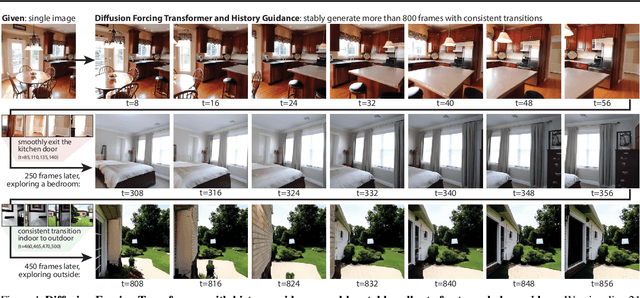
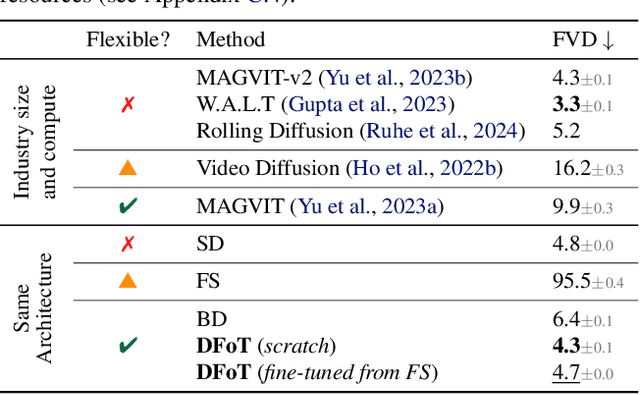
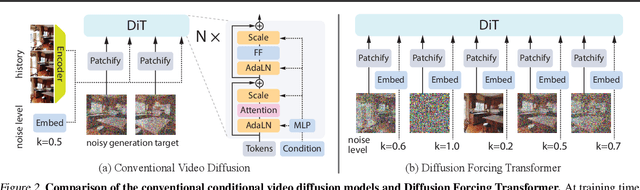
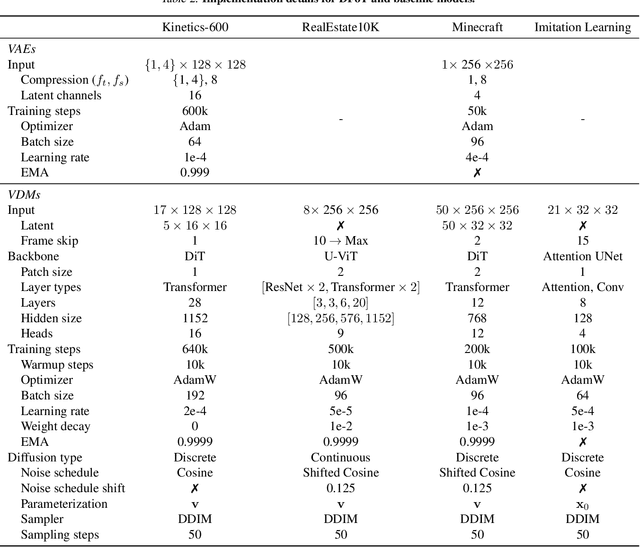
Classifier-free guidance (CFG) is a key technique for improving conditional generation in diffusion models, enabling more accurate control while enhancing sample quality. It is natural to extend this technique to video diffusion, which generates video conditioned on a variable number of context frames, collectively referred to as history. However, we find two key challenges to guiding with variable-length history: architectures that only support fixed-size conditioning, and the empirical observation that CFG-style history dropout performs poorly. To address this, we propose the Diffusion Forcing Transformer (DFoT), a video diffusion architecture and theoretically grounded training objective that jointly enable conditioning on a flexible number of history frames. We then introduce History Guidance, a family of guidance methods uniquely enabled by DFoT. We show that its simplest form, vanilla history guidance, already significantly improves video generation quality and temporal consistency. A more advanced method, history guidance across time and frequency further enhances motion dynamics, enables compositional generalization to out-of-distribution history, and can stably roll out extremely long videos. Website: https://boyuan.space/history-guidance
Self-Improvement in Language Models: The Sharpening Mechanism
Dec 02, 2024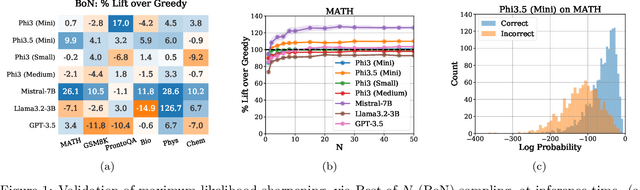

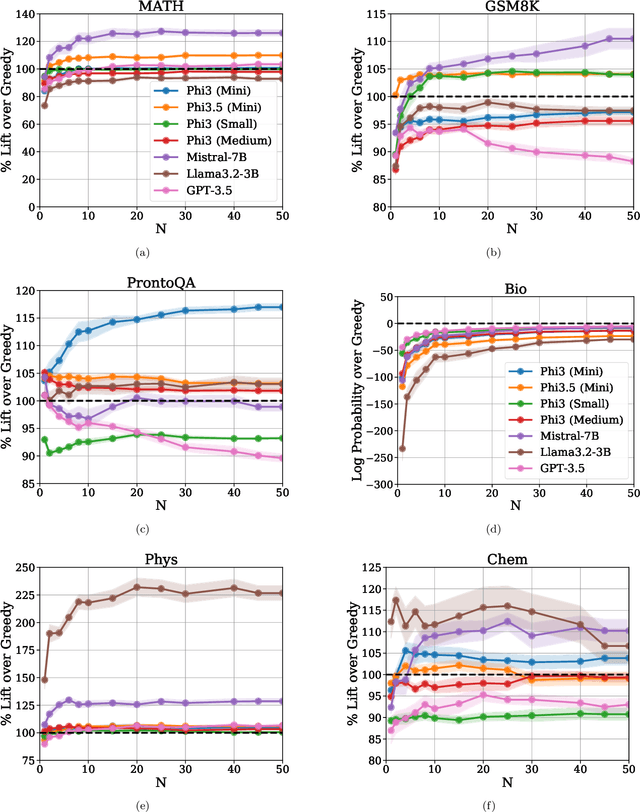
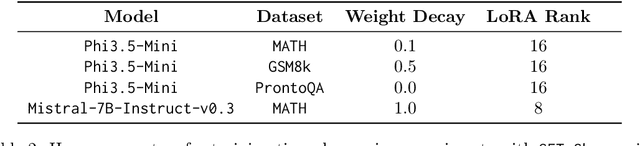
Recent work in language modeling has raised the possibility of self-improvement, where a language models evaluates and refines its own generations to achieve higher performance without external feedback. It is impossible for this self-improvement to create information that is not already in the model, so why should we expect that this will lead to improved capabilities? We offer a new perspective on the capabilities of self-improvement through a lens we refer to as sharpening. Motivated by the observation that language models are often better at verifying response quality than they are at generating correct responses, we formalize self-improvement as using the model itself as a verifier during post-training in order to ``sharpen'' the model to one placing large mass on high-quality sequences, thereby amortizing the expensive inference-time computation of generating good sequences. We begin by introducing a new statistical framework for sharpening in which the learner aims to sharpen a pre-trained base policy via sample access, and establish fundamental limits. Then we analyze two natural families of self-improvement algorithms based on SFT and RLHF.
Is Linear Feedback on Smoothed Dynamics Sufficient for Stabilizing Contact-Rich Plans?
Nov 14, 2024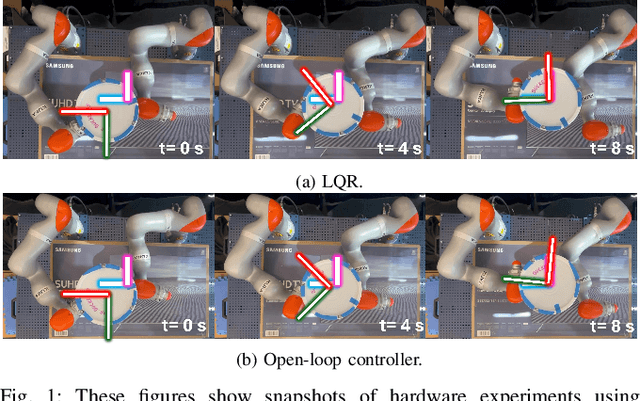
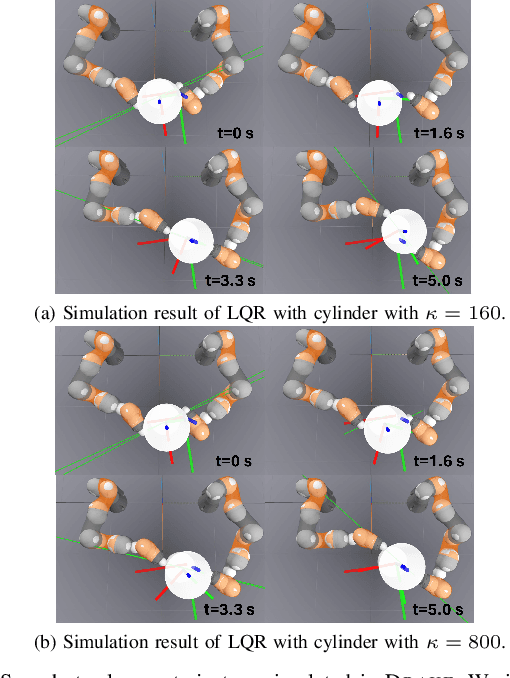


Designing planners and controllers for contact-rich manipulation is extremely challenging as contact violates the smoothness conditions that many gradient-based controller synthesis tools assume. Contact smoothing approximates a non-smooth system with a smooth one, allowing one to use these synthesis tools more effectively. However, applying classical control synthesis methods to smoothed contact dynamics remains relatively under-explored. This paper analyzes the efficacy of linear controller synthesis using differential simulators based on contact smoothing. We introduce natural baselines for leveraging contact smoothing to compute (a) open-loop plans robust to uncertain conditions and/or dynamics, and (b) feedback gains to stabilize around open-loop plans. Using robotic bimanual whole-body manipulation as a testbed, we perform extensive empirical experiments on over 300 trajectories and analyze why LQR seems insufficient for stabilizing contact-rich plans. The video summarizing this paper and hardware experiments is found here: https://youtu.be/HLaKi6qbwQg?si=_zCAmBBD6rGSitm9.
Faster Algorithms for Growing Collision-Free Convex Polytopes in Robot Configuration Space
Oct 16, 2024We propose two novel algorithms for constructing convex collision-free polytopes in robot configuration space. Finding these polytopes enables the application of stronger motion-planning frameworks such as trajectory optimization with Graphs of Convex Sets [1] and is currently a major roadblock in the adoption of these approaches. In this paper, we build upon IRIS-NP (Iterative Regional Inflation by Semidefinite & Nonlinear Programming) [2] to significantly improve tunability, runtimes, and scaling to complex environments. IRIS-NP uses nonlinear programming paired with uniform random initialization to find configurations on the boundary of the free configuration space. Our key insight is that finding near-by configuration-space obstacles using sampling is inexpensive and greatly accelerates region generation. We propose two algorithms using such samples to either employ nonlinear programming more efficiently (IRIS-NP2 ) or circumvent it altogether using a massively-parallel zero-order optimization strategy (IRIS-ZO). We also propose a termination condition that controls the probability of exceeding a user-specified permissible fraction-in-collision, eliminating a significant source of tuning difficulty in IRIS-NP. We compare performance across eight robot environments, showing that IRIS-ZO achieves an order-of-magnitude speed advantage over IRIS-NP. IRISNP2, also significantly faster than IRIS-NP, builds larger polytopes using fewer hyperplanes, enabling faster downstream computation. Website: https://sites.google.com/view/fastiris